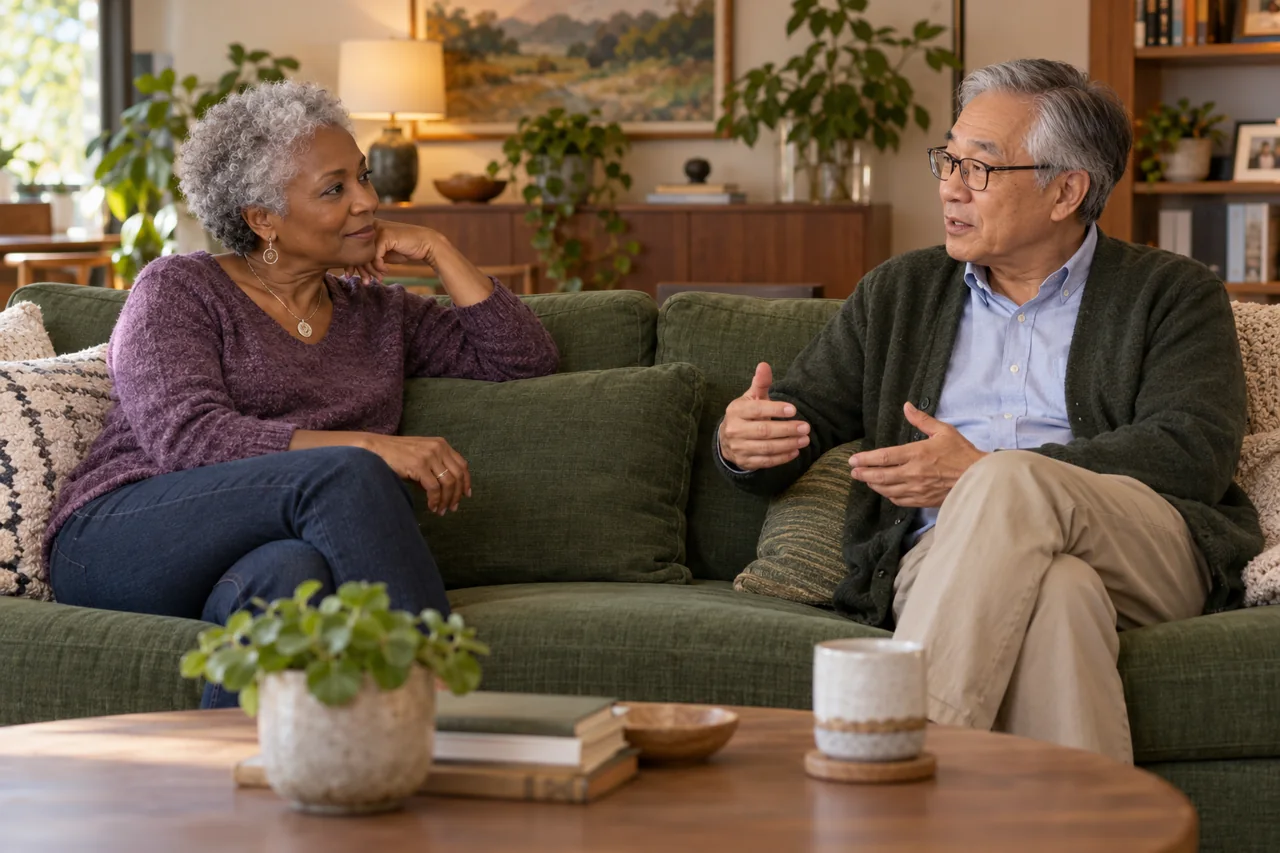
Share a Memory Without Assigning a Role
A story can explain something meaningful: why you love a place, how a family tradition began, or what shaped your life. Share it as a story about your history rather than an instruction for your date. “We used to visit this garden every spring” has a different effect from “My spouse always knew the right thing to say here.”
You do not need to remove every reference to a long marriage. Consider the balance of the conversation. Ask about the person in front of you too, and notice whether the story opens a connection or repeatedly closes space for their interests.
If You Are Dating Someone Who Was Widowed
You may feel uncertain when you hear affectionate memories or see photographs. Ask what you need to understand without treating the marriage as a rival. “Is this a place you would enjoy sharing with me, or would you prefer to keep it private?” allows a specific answer.
There is a separate concern if you are continually compared unfavorably. Address what happens: “When our choices are compared with what your spouse would have done, I feel that my preferences disappear.” You can respect the marriage and still expect consideration in the present.
Make Significant Dates Discussable
A birthday, anniversary or other meaningful day may call for company, privacy, a family ritual or an ordinary routine. The person who was bereaved may not know exactly how the day will feel. Explain what you know and leave room to revise the plan.
- “I would like to spend the morning with my family and see you for dinner.”
- “I would prefer a quiet day alone. Could we make our plans for Saturday instead?”
- “I am not sure what I will want, so I do not want to promise a celebration.”
These are illustrative ways to describe a preference. A partner can offer support without having to interpret silence or arrange a memorial gesture that has not been requested.
Give the New Relationship Its Own Language
Ask which terms feel accurate when introducing one another. Partner, girlfriend, boyfriend or simply a name may carry different meanings. Likewise, meeting family can mean courtesy to one person and a major commitment to another.
Discuss the actual next step rather than using memory as an explanation for every unanswered question. If you want exclusivity, ask about it directly. If either person cannot offer the relationship the other wants, kindness does not require leaving that difference unresolved. Building a first relationship after loss includes these milestones.
When the Conversation Needs a Boundary
You can say that a particular story is private or that you would rather discuss something else tonight. A new partner can also ask for time together that is not centered on the past. Neither request means erasing the marriage. Keep the boundary specific: “I would like this evening to be about getting to know each other” is more useful than demanding that a name never be mentioned.
If you are still deciding whether to begin dating at all, return to dating after widowhood. If a disagreement keeps repeating, focus on the behavior you each want changed through a clear conversation about the disagreement, rather than trying to establish whose feelings are more legitimate.